An industrial magnetic RJ45 temperature rating must cover the conditions in which the Ethernet port is expected to operate, including startup. A wider storage range does not extend a connector's operating range. The temperature printed beside a soldering instruction describes another condition again.
This distinction matters when an OEM selects a connector for an unheated cabinet, an enclosed gateway or equipment beside a heat source. The purchasing task is to identify a suitable part and its applicable conditions, rather than request an “industrial” version without a defined requirement. Two published GLGNET drawings provide a practical example of how to read the fields and turn them into a BOM specification.
Read the Industrial Magnetic RJ45 Temperature Rating Correctly
Begin with the field explicitly labeled operating temperature. It describes the specified operating range for that part; the supplier's documentation must establish the applicable electrical and environmental conditions. Check whether the stated temperature refers to the surrounding environment, a defined measurement location or another specified condition. Do not silently substitute a different measurement.
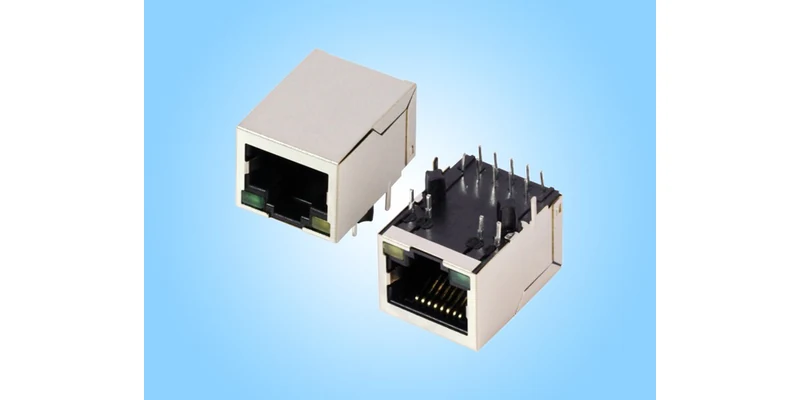
Storage temperature addresses a non-operating storage condition. GLGNET's JLFA1S805-G/YP drawing, file 130005-06811, lists operation from 0°C to +70°C and storage from −40°C to +85°C. The lower storage limit therefore cannot be used to approve powered Ethernet operation at −40°C.
The same mechanical sheet recommends wave soldering with a maximum peak temperature of 260°C for a maximum of 10 seconds. Those are process limits for the specified soldering operation. They establish neither continuous operation at that temperature nor permission to use any reflow profile with a similar peak.
| Temperature field | What the reader must establish | What it does not establish |
|---|---|---|
| Operating range | The permitted operating conditions for the exact part | Unlimited load or every environmental qualification |
| Storage range | The permitted non-operating storage conditions | Powered startup or data operation at its limits |
| Soldering limit | The named process, peak and time restriction | A continuous operating range or a different assembly process |
Keep these fields separate in the purchasing record. A supplier response containing only the broadest number leaves the operating requirement unresolved. Ask for the relevant drawing note and its conditions, then retain that document with the approved part number.
An outdoor-equipment description is also insufficient by itself. The enclosure, installation location and duty cycle determine what the connector encounters. Start with those conditions, then select a documented grade rather than treating “outdoor” or “industrial” as a complete electrical specification.
If supporting evidence includes a temperature-cycling or storage report, check what the specimen was doing during the exposure. A non-operating environmental test answers a different question from continuous Ethernet operation. Retain the test sequence and functional checks so that purchasing can distinguish an applicable result from a report carrying similar temperature numbers.
Compare Standard and Industrial Temperature MagJack Examples
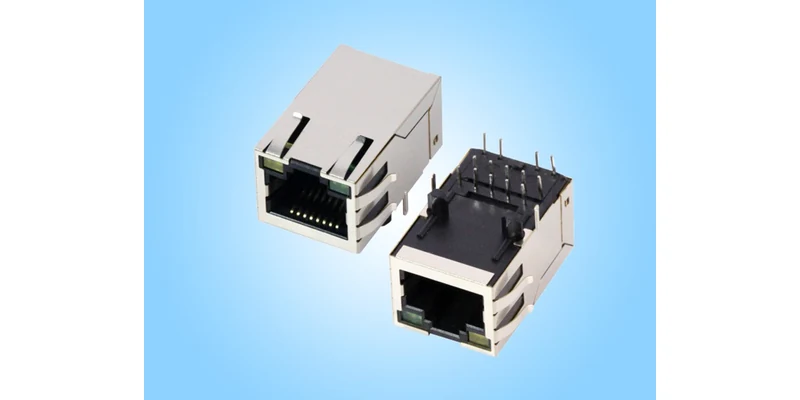
The JLFA1S805-G/YP and JGA1T802W-G/D1/P illustrate why an industrial temperature MagJack needs an exact model identity. Both are single-port Gigabit magnetic RJ45 products, but their operating ranges and mechanical arrangements differ.
The JGA1T802W-G/D1/P drawing, file 130008-02011, states −40°C to +85°C for both operation and storage. Its mechanical sheet also identifies a latch-up, through-hole arrangement. The standard-temperature example uses a latch-down arrangement. These are different components, rather than one unchanged footprint with a different temperature label.
| Published drawing field | JLFA1S805-G/YP | JGA1T802W-G/D1/P |
|---|---|---|
| Operating temperature | 0°C to +70°C | −40°C to +85°C |
| Storage temperature | −40°C to +85°C | −40°C to +85°C |
| Port arrangement | 1×1 | 1×1 |
| Latch arrangement | Down | Up |
| Listed Ethernet rate | 10/100/1000BASE-T | 10/100/1000BASE-T |
| Public drawing date | February 17, 2022 | October 19, 2022 |
These public documents make the distinction traceable, but a production approval needs the current controlled revision. Confirm that the offered sample, quotation and BOM reference the same configuration. A catalog family may contain several grades; a family-level statement cannot identify which one a quotation supplies.
Changing the temperature grade also requires reviewing the pinout, magnetic circuit, LED connections and enclosure fit. Matching data rates and port counts do not prove those details match. If a project is replacing an existing component, use the MagJack replacement assessment for that broader compatibility review.
An extended-temperature part may be a sensible candidate for a wider operating environment. Its selection still depends on the complete specification. Avoid paying for a grade label while leaving the actual PCB or PHY compatibility unchecked.
Specify the Magnetic RJ45 Connector Environment Inside the Equipment
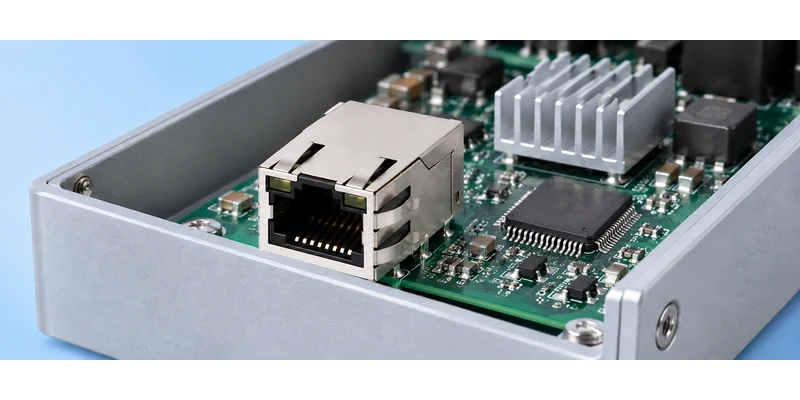
The relevant environment for a magnetic RJ45 connector is the one defined by its specification at its installed location. A room-temperature reading can miss the warmer conditions around a port beside PHYs, regulators or other heat-producing components. The enclosure can also change airflow compared with an open development board.
Document the minimum startup condition separately from the stabilized running condition. Equipment may be stored cold, powered while still cold and then warm internally during use. Qualification needs to address the stages the product is required to perform, rather than assuming a successful warm restart proves cold-start suitability.
For the upper limit, identify the operating combination likely to produce the most demanding local condition. Record enclosure closure, equipment orientation, neighboring loads and ventilation state. Where the device supports different operating modes, identify which mode was used to establish the requirement. This gives a supplier something more useful than an isolated maximum-temperature figure.
Measurement placement matters. A probe on the metal shield and a probe measuring nearby air answer different questions. Agree the measurement location and method against the supplier's rating definition. Record where the sensor was placed so that another engineer can interpret the result instead of comparing unlike readings.
Leave the required margin to the project's engineering assessment. There is no universal number of degrees to subtract from every connector rating. If the expected condition is close to a stated limit, discuss the uncertainty in the thermal estimate, manufacturing variation and applicable validation before deciding whether the candidate is adequate.
During chamber evaluation, record both the chamber setting and the installed measurement used for the design decision. The assembled device can create a local condition different from the chamber air. Keep the enclosure and loading configuration consistent when comparing candidates; otherwise, the result may describe a changed test setup rather than a difference between temperature grades.
Temperature is only one environmental dimension. A −40°C to +85°C operating range does not establish water ingress protection, dust sealing, vibration resistance or a complete equipment qualification. For a port exposed to moisture, assess that exposure separately. The industrial Ethernet connector guide covers the wider interface assessment; this temperature review supplies one defined input to it.
Check RJ45 With Integrated Magnetics Under the Required Conditions
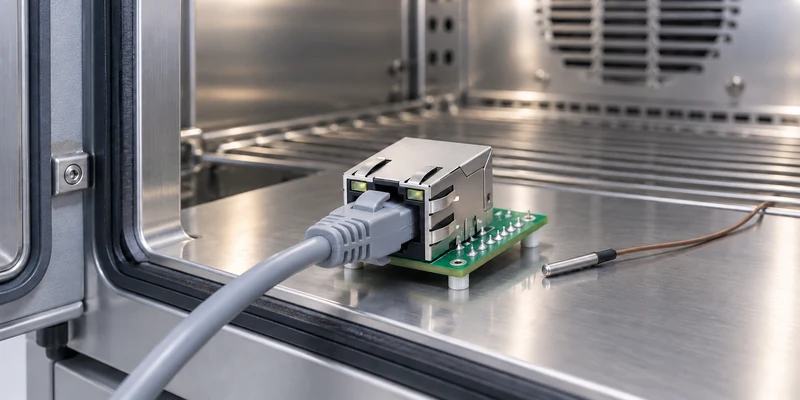
For RJ45 with integrated magnetics, the temperature grade must be considered alongside the specified magnetic circuit and electrical limits. A metal housing that fits the enclosure does not establish that the proposed part meets the Ethernet PHY's magnetics requirements over the intended conditions.
Read electrical values with their test conditions attached. For example, file 130008-02011 lists a minimum open-circuit inductance of 350 µH at 100 kHz and 100 mV with 8 mA DC bias. The frequency, excitation and bias belong to that inductance specification. The 8 mA figure is not a PoE current rating, and the inductance value alone cannot establish overall compatibility.
Review the parameters relevant to the selected PHY, including the circuit topology, turns ratio and specified loss or rejection limits. Ask which limits are supported across the requested operating range and what supporting information is available. A value presented without an explicit temperature condition should not be expanded into an invented temperature-performance curve.
If the equipment needs PoE, select a candidate documented for that requirement and review its current path and thermal conditions separately. Both GLGNET examples in this article are listed without PoE support. Their temperature ranges therefore provide no evidence that those specific parts can be used for a proposed powered port.
For validation, test the Ethernet interface in the conditions the product must meet. Check startup and link establishment at the required low-temperature condition, then assess sustained operation under the relevant high-temperature and loading condition. Define the cable, link partner, speed, activity and pass criteria in the test plan rather than reporting only that an LED illuminated.
Retain the configuration with the results. Connector and PHY part numbers, board revision, firmware version and enclosure condition help establish what was evaluated. If the surrounding design changes, review whether the previous evidence still answers the thermal and electrical questions. A test report is useful only when it can be connected to the assembly being approved.
Put the RJ45 MagJack Temperature Grade in the BOM and RFQ
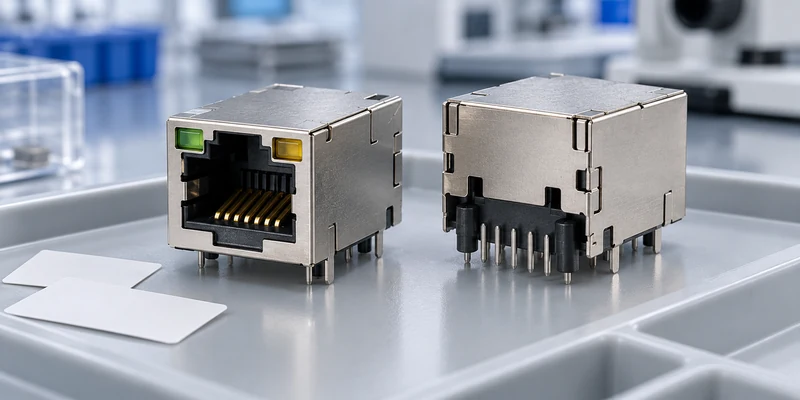
A purchasing description such as “industrial RJ45 MagJack” leaves too much open to interpretation. The BOM should identify the manufacturer's complete part number, the approved drawing revision and the required operating grade. Keep storage and assembly-process requirements in their own fields.
Describe the intended operating conditions in the request for quotation. Include the required low-temperature startup, continuous-use environment and the rating's agreed reference location. Add the Ethernet PHY, target data rate, PoE requirement and any fixed mechanical or LED constraints. The supplier can then identify a candidate against the real requirement rather than quote a visually similar jack.
When evaluating an industrial RJ45 connector manufacturer, ask how the offered grade is identified on the quotation and sample documentation. If the same family contains both standard and extended-temperature variants, the exact ordering code and controlled specification should remove the ambiguity. Do not rely on a product photograph or a broad family heading to distinguish them.
| Approval record | Information to retain |
|---|---|
| Part identity | Complete ordering code and controlled drawing revision |
| Operating requirement | Range, startup condition and defined temperature reference |
| Other limits | Storage range and the separately approved soldering process |
| Electrical match | PHY, data rate, magnetic circuit and any PoE requirement |
| Verification | Test conditions, results and the assembly revision evaluated |
Define how substitutions or specification changes will be handled. A purchasing substitution that changes the operating grade needs engineering review, even when the package appears similar. Conversely, a wider temperature statement alone is insufficient to approve a part with different circuitry or terminals.
Carry that identity into goods receipt and production records. Retain the supplied part designation and lot information with the approved specification, and clarify how an incoming shipment is distinguished from another grade in the same family. This closes the gap between the engineering selection and the material actually installed on the board.
GLGNET's magnetic RJ45 connector range provides a starting point for matching the interface requirements. Send the required internal temperature conditions, startup duty, PHY, power requirement and existing connector drawing to discuss a suitable grade and the documentation needed for sample evaluation.
Industrial Magnetic RJ45 Temperature Rating FAQs
Can a connector rated for −40°C storage operate at −40°C?
Storage approval does not establish powered operation there. Check the operating range for the exact part. The JLFA1S805-G/YP drawing illustrates this distinction with a −40°C storage limit but a 0°C minimum operating temperature.
Does an industrial temperature grade also give the port an IP rating?
No. Temperature and ingress protection address different conditions. A wide operating range does not establish sealing against water or dust; assess the selected connector and enclosure arrangement for the required exposure separately.
Can a 0–70°C MagJack be approved solely from the room temperature?
No. Establish the specified temperature condition at the installed connector and include the equipment's startup and loaded operation. Room temperature alone does not describe the thermal environment inside the assembled equipment.
For related connector guidance, review the ganged vs. stacked magnetic RJ45 layout guide, the RJ45 LED connector troubleshooting guide, the 2.5G vs 5G vs 10GBASE-T MagJack selection guide, the PoE magnetic RJ45 connector guide, and the custom connector design checklist. Browse GLGNET’s magnetic RJ45 connector portfolio or explore networking connectivity solutions for more.