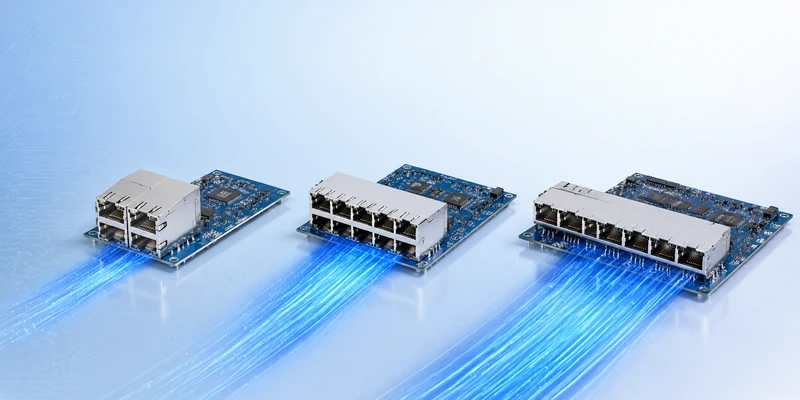
This article will introduce the connection methods for 10G SFP+ to RJ45, and analyze the common challenges encountered during data center deployment, along with their corresponding solutions.
What is 10G SFP+ to RJ45
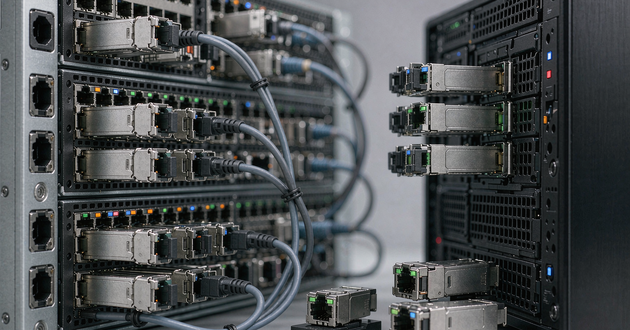
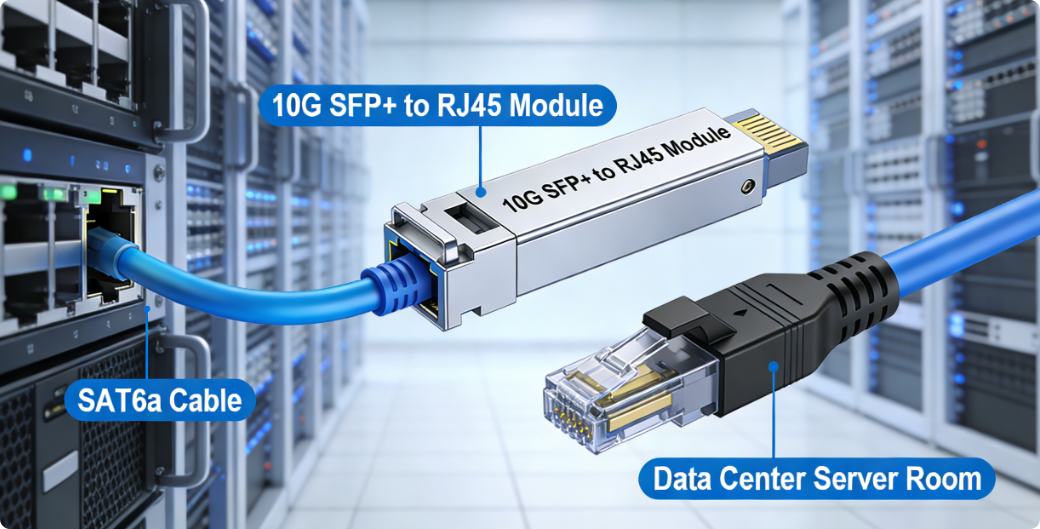
A 10G SFP+ to RJ45 module is a high-speed Ethernet interface that connects SFP+ ports on network devices to CAT6a or CAT7 copper cables, enabling 10GbE network transmission. This module allows data centers and enterprise networks to achieve high-bandwidth connectivity over existing copper cabling without the need for new fiber installations. It is widely used for direct server-to-switch connections, storage interconnects, and networking for AI or high-performance computing nodes, providing a flexible and efficient solution for upgrading network infrastructure.
Why Use SFP+ to RJ45 and the Importance of SFP/SFP+/QSFP Connectors
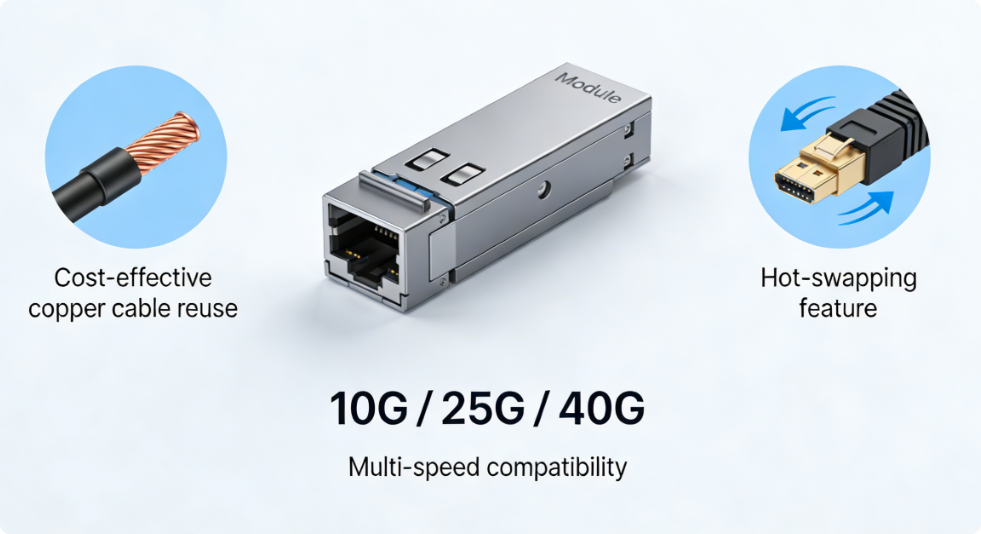
Using SFP+ to RJ45 modules offers multiple advantages. First, they are cost-effective, making full use of existing copper cabling without the need for additional fiber deployment, thereby reducing network upgrade costs. Second, these modules are flexible in design and support hot-swapping, allowing for quick deployment and upgrades over short distances. Finally, SFP+ to RJ45 modules are highly compatible, capable of auto-negotiating 1G, 2.5G, 5G, and 10GbE speeds, adapting to different devices and network environments, and providing efficient and reliable connectivity for data centers and enterprise networks.
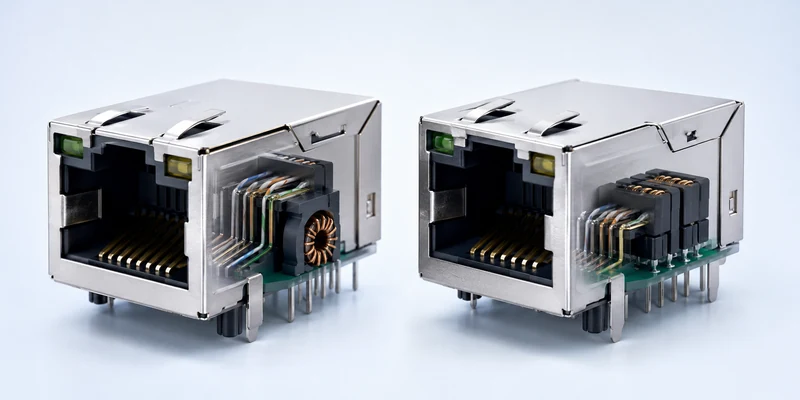
Even though the modules themselves offer clear advantages, the quality of the interface remains critical for stable operation in real-world networks. The interface carries high-speed signals, and its design directly affects signal integrity and transmission stability. Poor contact or insufficient mechanical strength may result in signal degradation, packet loss, or even network outages. During high-speed transmission, electromagnetic interference (EMI) around the interface can also affect signal quality. The interface must withstand frequent insertions and removals without damaging the module or the equipment.
SFP+ to RJ45 10G Connectivity Solution
When deploying a SFP+ to RJ45 10G network in a data center, in addition to selecting the appropriate 10GBASE-T RJ45 modules, it is also essential to consider multiple factors such as interface design, signal integrity, EMI shielding, thermal management, and maintainability to ensure overall link stability. The following are common challenges and corresponding solutions:
1. Module Compatibility with Switch/Server Interfaces
When deploying a SFP+ to RJ45 10G network in a data center, SFP+ modules from different vendors may vary slightly in mechanical size, electrical specifications, or insertion force. Poor interface design can make modules difficult to insert or result in poor contact, affecting data transmission stability and potentially causing link failures.
As the physical and electrical interface for modules, the SFP+ cage must strictly follow MSA (Multi-Source Agreement) standards. Otherwise, issues such as impedance discontinuity, uneven insertion resistance, or unstable contact may occur, which can degrade high-speed signal transmission. MSA standards define cage dimensions, tolerances, metal shielding, and electrical contact requirements, which are critical for module compatibility.
GLGNET optimized its SFP+ cage to address these challenges. The housing uses high-precision stamping or casting with a tolerance of ±0.05mm, ensuring moderate insertion force—neither too tight nor too loose. The internal contact pins are made of durable copper alloy with gold plating ≥30μin, reducing contact resistance and supporting over 10,000 insertion cycles while maintaining signal quality.
For electrical compatibility, the cage is optimized for differential impedance, ensuring it works with a wide range of 10G SFP+ and 10GBASE-T RJ45 modules, reducing signal reflection and insertion loss. The mechanical structure includes dual locking and guide design, keeping modules securely in place even in high-density racks or environments with vibration.
GLGNET follow MSA standards for dimensions and layout and are also compatible with SFP28 modules. This allows customers to upgrade or replace modules without changing rack or device layouts.
With these design optimizations, SFP+ cages provide mechanical and electrical compatibility, long lifespan, high reliability, and stable signal transmission in high-density environments, forming a solid foundation for 10G SFP+ to RJ45 deployments.
2. High-Speed Signal Integrity and EMI Interference
During 10Gbps transmission, interface design has a direct impact on signal integrity (SI). Impedance discontinuities, insufficient shielding, or EMI interference can increase bit error rates and cause unstable links.
In high-speed connections like SFP and QSFP pluggable modules, strong EMI suppression and shielding help reduce electromagnetic interference and protect differential signals. Impedance mismatches can lead to signal reflection, crosstalk, and eye diagram closure. These issues reduce overall link performance.
GLGNET SFP+/SFP28/QSFP cages use a full-metal shielding housing with a multi-point grounding structure. This design forms a stable electromagnetic shielding environment and reduces external noise around high-speed signals.
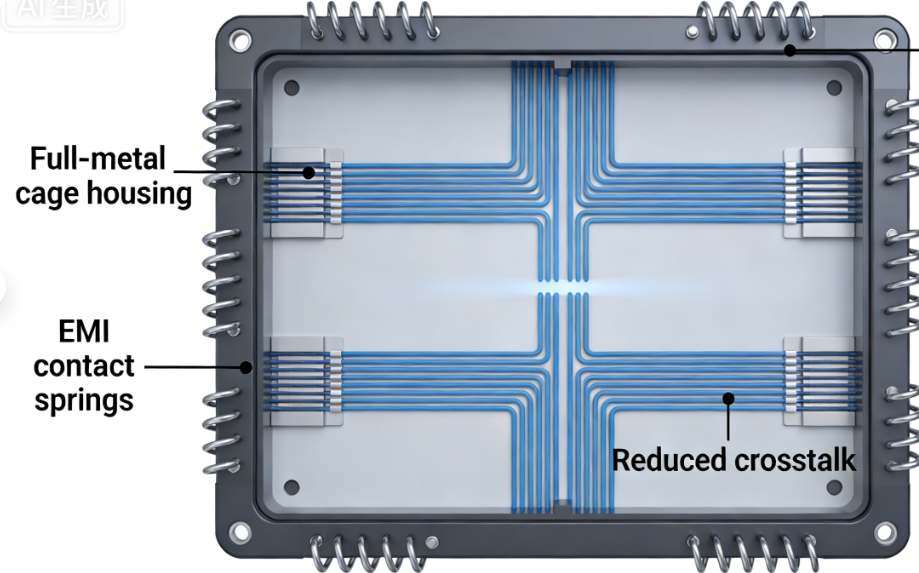
The cage integrates high-elasticity EMI contact springs. When a module is inserted, the springs create stable metal contact points. Shielding continuity improves and radiated interference is reduced.
The internal signal channel layout is carefully optimized. Differential signal paths remain symmetrical and stable. Impedance matching helps reduce signal reflection and insertion loss. The structure lowers crosstalk risk and improves signal integrity, supporting stable transmission for 10G and higher-speed networks.
3. High-Density Rack Cabling and Thermal Management
High-density rack environments contain many device ports. Heat can accumulate quickly. Copper modules like 10GBASE-T RJ45 often consume more power and generate additional heat. Poor heat dissipation may cause module overheating, performance degradation, or reduced service life.
Temperature rise can still occur in dense slot environments, even with high-quality modules. Cage design must support reliable signal transmission and effective thermal management.
Our cages support high-density deployment and efficient heat dissipation. The metal housing provides EMI shielding and functions as a thermal conduction path. Part of the module heat transfers to the device chassis or surrounding airflow.
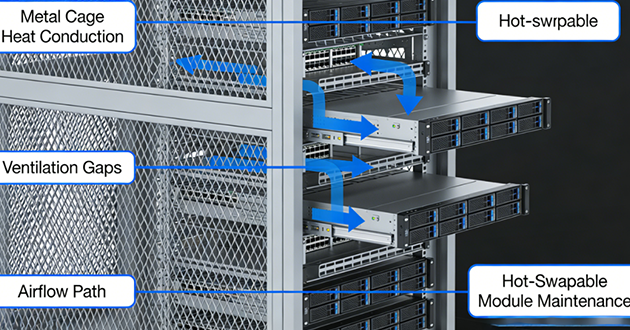
Ventilation gaps and thermal pathways improve airflow inside the rack. Heat buildup around modules is reduced.
GLGNET SFP cages support standard hot-swappable structures. Modules can be installed or replaced while the system remains running. Maintenance impact on system operation and thermal balance becomes minimal. Data center service efficiency improves.
4. Module Maintenance and Upgrade Flexibility
In data center operations, modules are regularly replaced or upgraded. Network bandwidth often moves from 10G to 25G or higher. Restrictive interface structures make module insertion and removal difficult. PCB or module damage may occur during maintenance.
SFP interfaces must support high-speed transmission and long mechanical life. Operational convenience is equally important in environments with frequent upgrades and maintenance.
Our use optimized mechanical guiding structures. Modules stay aligned during insertion. The risk of misalignment or incorrect insertion decreases.
Insertion force is carefully engineered and tested. Connections remain stable. Routine maintenance becomes easier and safer.
The standardized cage design supports compatibility with SFP+, SFP28, and some QSFP modules. Network upgrades can proceed without redesigning device interfaces or rack layouts. Bandwidth expansion becomes smoother.
5. Support for Short-Distance and Multi-Rate Connections
Network environments vary in transmission speed and distance requirements. CAT6a or CAT7 copper cables typically support about 30 meters of 10G transmission. Some NBase-T modules extend the distance to around 100 meters. Poor signal path quality in the interface can further reduce link performance.
The SFP+ cage is the first transmission interface between the module and the device. Impedance matching, contact stability, and structural design influence supported data rates and bit error performance.
Our cages feature optimized high-speed signal paths. They support multiple data rates including 1G, 2.5G, 5G, 10G, and even 25G.
Stable contact structures and reliable signal paths maintain consistent signal quality across different speeds.
The high-reliability interface maintains stable communication within specified transmission distances. Servers, storage systems, and switches receive dependable connectivity. Data centers and enterprise networks gain flexible multi-rate deployment support.
FAQs
1.How far can a 10G SFP+ to RJ45 connection reach?
A 10G SFP+ to RJ45 connection typically supports up to 30 meters using CAT6a or CAT7 copper cables. Some NBase-T modules can extend the transmission distance to around 100 meters, depending on the cable quality and network environment.
2.Why is the SFP+ cage important?
The SFP+ cage serves as the physical interface for pluggable modules. It provides a stable slot connection while ensuring signal integrity, EMI shielding, and proper heat dissipation, all of which are essential for reliable high-speed network performance.
3.Can the network be upgraded to higher bandwidth in the future?
Yes. With standardized interface design, upgrades are straightforward. GLGNET SFP28 cages support 25G, while QSFP cages support 40G and 100G, allowing data centers to scale bandwidth smoothly without major hardware redesign.
4.Is hot-swapping safe for SFP modules?
Yes. GLGNET cages are designed to support standard hot-swappable operation, allowing modules to be installed or replaced while the system remains powered on. This simplifies maintenance and reduces network downtime.
Read more:
https://www.glgnet.biz/articledetail/how-do-i-know-if-sfp-connector-module-is-compatible.html
https://www.glgnet.biz/articledetail/can-sfp-and-sfp-connector-modules-be-used-together.html
Conclusion
Optimized structural design, strong EMI shielding, and stable signal paths allow GLGNET SFP+/SFP28/QSFP cages to provide a reliable interface for 10G SFP+ to RJ45 networks while supporting future upgrades to 25G, 40G, or higher bandwidth.
For data centers, enterprise networks, and AI computing environments, reliable connector solutions help improve network stability and long-term scalability.
Contact GLGNET for SFP cage connectors or customized connectivity solutions for your network equipment.