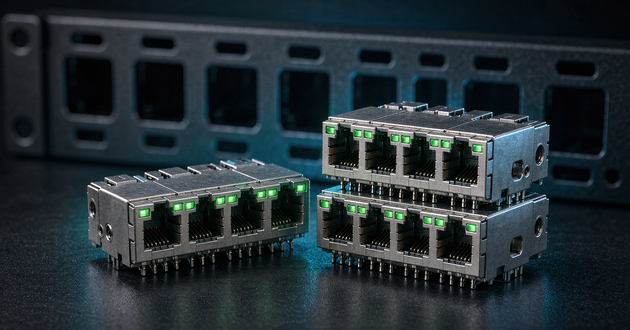
There is no single answer to whether SFP or RJ45 is better. The better choice depends on your network distance, speed requirement, cabling environment, power consumption, EMI conditions, equipment design and future expansion plan.
What Are SFP and RJ45?
Before comparing SFP and RJ45, it is important to understand that they are not exactly the same type of component.
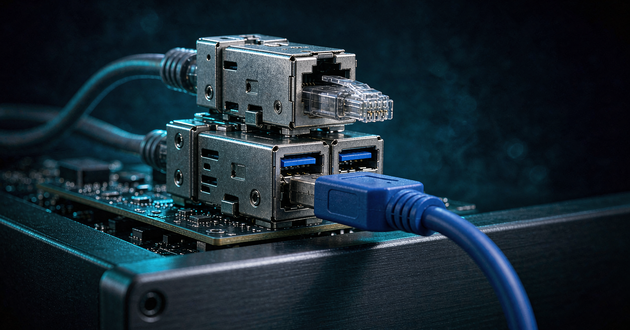
An SFP port is a small form-factor pluggable interface. It is designed to work with different transceiver modules, such as fiber optic modules, copper modules or direct attach copper cables. Because the module can be replaced, SFP ports give network equipment more flexibility in distance, media type and deployment method.
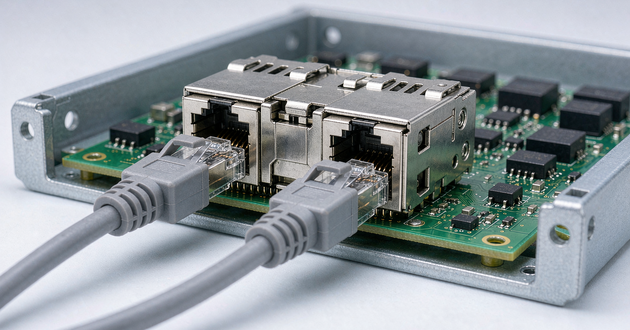
An RJ45 port is the standard Ethernet interface used with twisted-pair copper cables such as Cat5e, Cat6 and Cat6A. It is commonly found on routers, switches, gateways, computers, industrial controllers, IP cameras, wireless access points and many other Ethernet devices.
In simple terms, RJ45 is usually used for copper Ethernet access, while SFP is often used for flexible uplinks, fiber transmission and long-distance network connections.
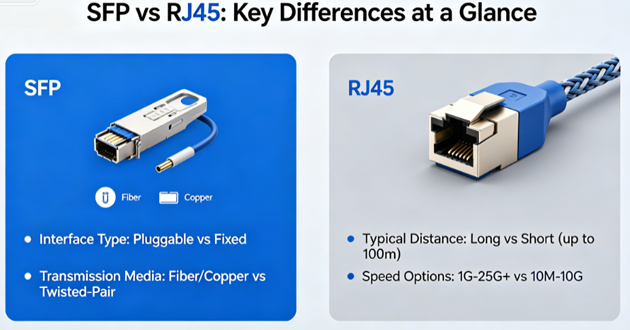
SFP vs RJ45: Key Differences at a Glance
Factor | SFP | RJ45 |
Interface Type | Pluggable module interface | Fixed copper Ethernet interface |
Transmission Media | Fiber, copper module or DAC | Twisted-pair copper cable |
Typical Distance | Short reach to long-distance fiber links | Usually up to 100 meters |
Speed Options | 1G, 10G, 25G or higher depending on port and module | 10/100M, 1G, 2.5G, 5G, 10G |
EMI Resistance | Stronger with fiber connection | Depends on cable, shielding and grounding |
Power Consumption | Usually lower with fiber or DAC in high-speed links | Can be higher in 10G copper applications |
Deployment Cost | Higher initial module and fiber cost | Lower initial cabling and port cost |
Flexibility | High, module-based | Simple and widely compatible |
Typical Use | Uplinks, backbone, data centers, industrial fiber networks | LAN access, PoE devices, office networks, endpoint connections |
Both interfaces have their own value. RJ45 is easier to deploy and widely supported. SFP provides more flexibility and is often better for longer distance, higher density and more demanding network environments.
Speed: Is SFP Faster Than RJ45?
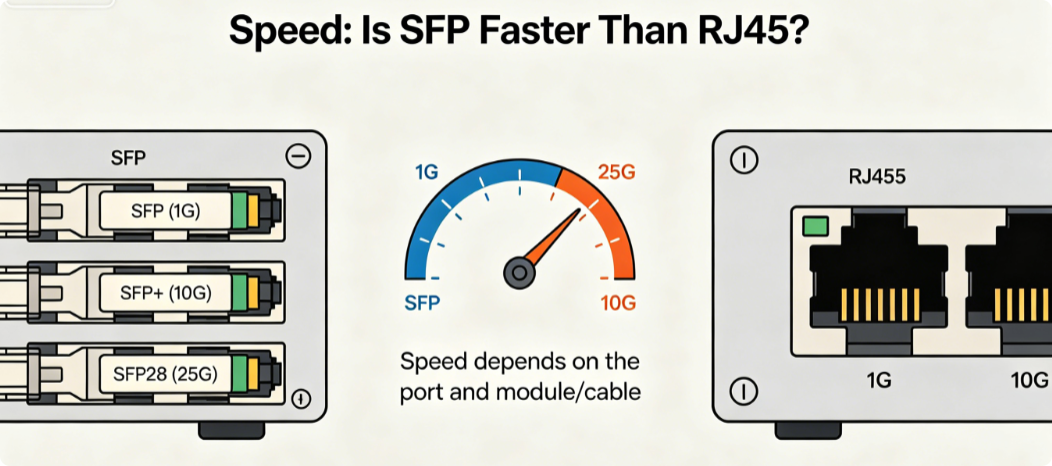
SFP is not automatically faster than RJ45. The actual speed depends on the Ethernet standard, the port design and the module used.
For example, a 1G RJ45 port and a 1G SFP port can both support Gigabit Ethernet. A 10G RJ45 port and a 10G SFP+ port can both support 10 Gigabit Ethernet. In this case, the difference is not simply the speed number, but the actual performance in power consumption, latency, heat, cable distance and system design.
For many short-distance copper connections, RJ45 can provide reliable performance at a lower cost. This is why RJ45 is still widely used in office networks, access switches, industrial controllers and PoE equipment.
However, in 10G or higher-speed network systems, SFP+ is often preferred for switch uplinks, server connections and data center environments. SFP+ fiber modules or DAC cables are commonly used where lower power consumption, lower latency and higher port density are important.
It is also important to distinguish between SFP, SFP+ and SFP28. SFP is commonly associated with 1G Ethernet, SFP+ is commonly used for 10G Ethernet, and SFP28 is commonly used for 25G Ethernet. They may look similar, but their supported speed and electrical performance are different.
Distance: When Does SFP Have a Clear Advantage?
Distance is one of the biggest differences between SFP and RJ45.
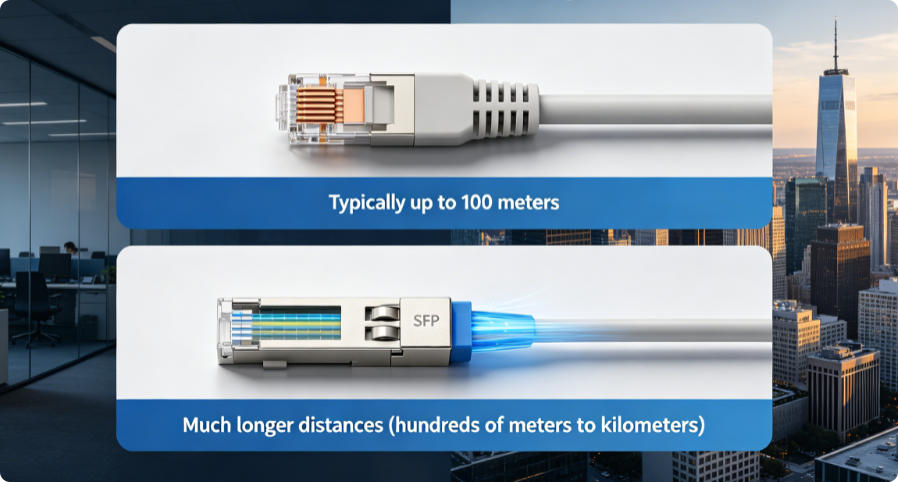
RJ45 Ethernet connections are usually used within 100 meters when matched with suitable copper cables. This is enough for most office networks, home networks, IP cameras, wireless access points, access control systems and many industrial control applications.
For short-distance connections, RJ45 is practical and cost-effective. The cables are easy to find, installation is familiar to most technicians, and the interface is compatible with many types of Ethernet equipment.
SFP has a clear advantage when the network link needs to go beyond the copper cable distance limit. With fiber optic transceivers, SFP can support much longer transmission distances, from hundreds of meters to several kilometers or more depending on the module and fiber type.
Cost: Which One Is More Cost-Effective?
RJ45 usually has a lower initial deployment cost. Copper Ethernet cables are widely available, the port cost is relatively low, and most installers are familiar with RJ45 cabling. For many access-layer networks, RJ45 is the more economical choice.
This is especially true when the project already has existing copper cabling. Reusing current RJ45 infrastructure can reduce installation cost and shorten deployment time.
SFP often requires additional modules and fiber cabling, so the initial cost may be higher. However, in some high-density, long-distance or high-speed networks, SFP can provide better long-term value.
SFP vs RJ45 in 10G Networks: Power Consumption, Heat and EMI
Power consumption and heat are important factors in 10G networks and high-density equipment. Although RJ45 is convenient for copper Ethernet, 10GBASE-T RJ45 connections usually generate more heat than SFP+ fiber or DAC solutions.
In compact switches, routers, gateways and industrial network devices, excessive heat can affect airflow design, component lifetime and long-term reliability. This is why SFP+ fiber modules or DAC cables are often used in high-density 10G environments, especially in data centers, server rooms and network backbone systems.
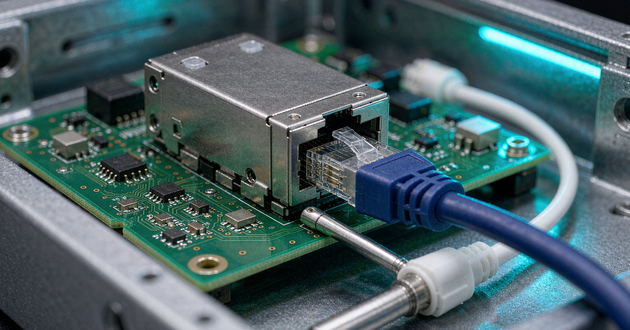
EMI is another key consideration. RJ45 uses electrical signals through copper cables, so cable quality, shielding, grounding and connector design can directly affect signal stability. In industrial or outdoor environments, a shielded RJ45 connector or RJ45 jack with magnetics can help improve EMI protection and reduce unstable transmission risks.
SFP fiber has a natural advantage in EMI resistance because it transmits optical signals instead of electrical signals. This makes SFP fiber suitable for factories, power systems, rail transportation, outdoor cabinets and other harsh environments where stable long-distance communication is required.
For equipment manufacturers, the interface choice should be considered together with PCB layout, port density, heat dissipation, metal cage structure, shielding design and front-panel space.
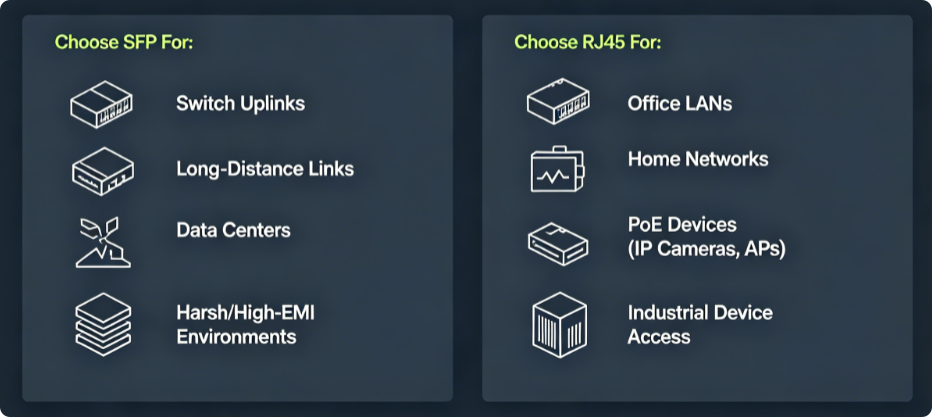
Application Scenarios: When to Choose SFP or RJ45
Network Requirement | Recommended Interface | Typical Applications |
Short-distance Ethernet access | RJ45 | Office LAN, home networks, desktop computers, routers, gateways |
PoE device connection | RJ45 | IP cameras, wireless access points, VoIP phones, access control systems |
Industrial device access | RJ45 | Industrial controllers, security devices, local Ethernet equipment |
Switch uplinks | SFP | Access switches, aggregation switches, enterprise networks |
Long-distance transmission | SFP | Campus networks, inter-building links, outdoor cabinets |
High-density network systems | SFP / SFP+ | Data centers, server rooms, backbone networks |
Harsh or high-EMI environments | SFP fiber | Industrial fiber networks, telecom equipment, power systems |
From Device Design View: SFP Cage or RJ45 Connector?
For equipment manufacturers, choosing between SFP and RJ45 is not only a network performance decision. It also affects PCB layout, front-panel design, enclosure structure, heat dissipation, EMI shielding and long-term production reliability.
1.RJ45 Connector Design Considerations
When using an RJ45 connector, engineers need to consider whether the port requires integrated magnetics, PoE support, LED indicators, shielding or a specific PCB mounting method. The connector height, port direction and front-panel opening should also match the equipment structure.
For switches, routers, gateways, security devices and industrial controllers, a shielded RJ45 connector can improve EMI protection, while an RJ45 jack with magnetics can help simplify Ethernet circuit design and support more stable signal transmission.
2.SFP Cage and Connector Design Considerations
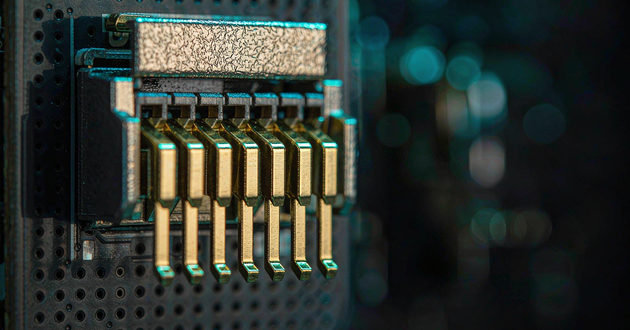
SFP ports require a suitable cage and connector structure to support pluggable modules. Key factors include SFP, SFP+ or SFP28 compatibility, EMI shielding, heat sink design, light pipe position, PCB mounting and module insertion reliability.
For high-speed switches, routers, telecom equipment and industrial network devices, the SFP cage design can affect mechanical fit, signal integrity, heat dissipation and long-term durability.
3.How Interface Choice Affects Product Design
RJ45 is usually easier for short-distance copper access, while SFP is more flexible for fiber uplinks and long-distance connections. However, both interface types must match the PCB, enclosure, front panel and thermal design.
In compact or high-density network equipment, even small interface differences can affect internal layout, port density, airflow and user maintenance. That is why OEM equipment manufacturers should confirm the interface choice early in the product design stage.
FAQ About SFP vs RJ45
1.Is SFP better than RJ45?
SFP is better for long-distance links, fiber networks, uplinks, high-density network systems and environments with strong electromagnetic interference. RJ45 is better for short-distance copper Ethernet, endpoint access, PoE devices and cost-sensitive deployments. The better option depends on the actual network requirement.
2.Is SFP faster than RJ45?
Not always. Speed depends on the port standard and module type. A 1G SFP port and a 1G RJ45 port can both support Gigabit Ethernet. A 10G SFP+ port and a 10G RJ45 port can both support 10G Ethernet. The difference is usually in distance, latency, power consumption, heat and deployment environment.
3.Can I connect an SFP port to an RJ45 port?
Yes. An SFP port can connect to an RJ45 copper network by using a compatible RJ45 SFP module. However, users should check the supported speed, cable type, maximum distance, device compatibility and heat dissipation requirements.
4.Does RJ45 support 10G Ethernet?
Yes. RJ45 can support 10G Ethernet through 10GBASE-T, usually with suitable Cat6A or better cabling. For reliable 10G copper transmission, cable quality, installation quality, shielding and distance should be carefully considered.
5.Does SFP support copper cable?
Yes. SFP or SFP+ ports can support copper connections through copper transceiver modules or DAC cables, depending on the equipment and module compatibility. However, SFP is often selected because it can also support fiber modules for longer-distance transmission.
6.Which is better for PoE devices?
RJ45 is the better choice for PoE devices because copper Ethernet cabling can carry both power and data. This makes RJ45 suitable for IP cameras, wireless access points, VoIP phones, access control systems and other powered Ethernet devices.
7.Which is better for industrial networks?
For short-distance equipment access, RJ45 is still widely used in industrial networks. For long-distance transmission or high-EMI environments, SFP fiber is usually more reliable. Many industrial switches use both RJ45 ports for local access and SFP ports for fiber uplinks.
8.Which interface should equipment manufacturers choose?
Equipment manufacturers should choose RJ45 when the product needs copper Ethernet access, PoE support, low-cost deployment or direct connection to endpoint devices. SFP is more suitable when the product needs fiber uplinks, long-distance transmission, high-speed expansion or stronger EMI resistance.
Conclusion
For network users, the right choice depends on speed, distance, cabling, power, cost and application environment. For equipment manufacturers, the choice also affects PCB design, enclosure structure, heat dissipation, EMI shielding and long-term production reliability.
GLGNET provides RJ45 connectors, RJ45 jacks with magnetics, SFP cages and SFP+ connector solutions for Ethernet equipment, network switches, routers, gateways, telecom devices and industrial network systems. If you are designing or upgrading network equipment, selecting the right interface component can help improve signal stability, mechanical fit and long-term product reliability.