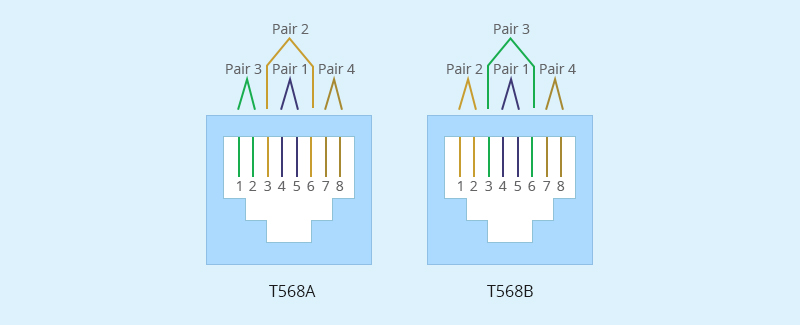
Many people often only focus on the performance of the module itself, but easily overlook another equally important component — the SFP+ cage. In fact, the thermal structure and EMI shielding design of the cage will directly affect the stability of the module and the overall performance of the device. This article uses the SFP+ to RJ45 10G module to understand the importance of the correct SFP+ cage, which is very important for ensuring stable network operation.
Brief Outline:
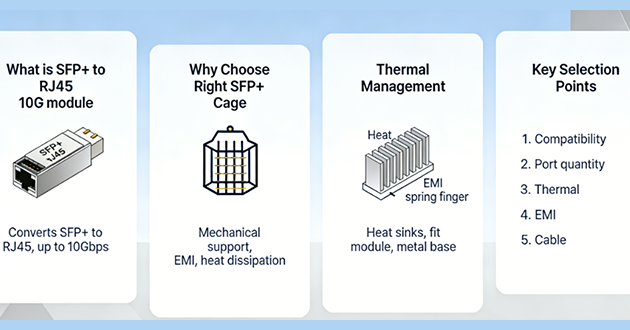
What is SFP+ to RJ45 10G module
The SFP+ to RJ45 10G module converts the SFP+ optical port on the device into a standard RJ45 Ethernet interface, enabling Ethernet speeds of up to 10Gbps. If the heat dissipation and EMI shielding design of the SFP+ cage are not reasonable, it may trigger device throttling or disconnection, and will affect the stability of the entire network.
Why Choosing the Right SFP+ Cage Is Important
Because the SFP+ cage performs three very critical functions — “reliable mechanical support, providing effective EMI grounding and shielding, and helping the module dissipate heat.”
Thermal Management of SFP+ Cages
In high-speed copper transmission, each port of the 10GBASE-T SFP+ module generates a large amount of heat. The module is small in size and has dense copper traces, which causes heat to accumulate quickly and the temperature to rise. GLGNET’s SFP+ cage is equipped with high-quality heat sinks and can save PCB space, ultimately efficiently reducing the module surface temperature and stabilizing network transmission.
EMI Shielding Design of SFP+ Cages
When using the SFP+ to RJ45 10G module, the signals on the high-speed copper lines can “interfere with each other,” creating “noise hotspots,” and may even interfere with other devices. GLGNET’s SFP+ cage contains EMI spring fingers, which fit tightly against the module’s metal housing, and the cage’s metal base is soldered or screwed to the PCB, ensuring signal stability and reducing the bit error rate.
Key Points for Selecting an SFP+ Cage
Five key factors:
1. Standard compatibility — the SFF-8431 and SFF-8432 compatibility standards are the most important. GLGNET happens to meet both of these key standards and cooperates with well-known brands such as Huawei and ZTE.
2. Port quantity — different numbers of ports suit different usage scenarios. A single-port SFP+ cage only supports one SFP+ module, while multi-port cages support multiple modules, increasing port density.
3. Thermal structure — many manufacturers, including GLGNET and Cisco, consider that the cage’s thermal structure is very important for effectively helping device heat dissipation.
4. EMI shielding capability — insufficient shielding can increase the bit error rate, and GLGNET precisely addresses this issue.
5. Cable compatibility — network cabling exists in two different structures, UTP and STP. Generally, GLGNET cages can adapt to both network environments, ensuring stable signal transmission.
The detailed content follows below.
What is an SFP+ to RJ45 10G Module
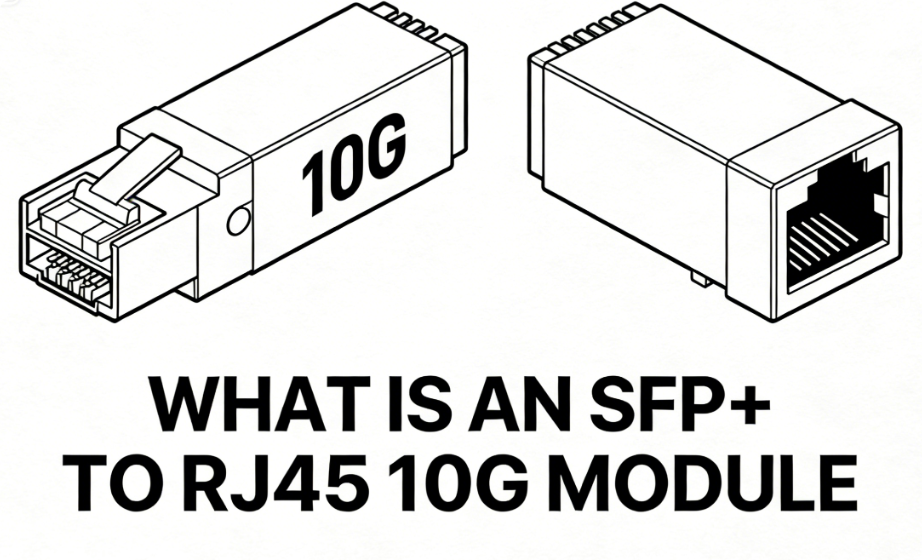
If you are considering upgrading your network, or need to achieve 10Gbps high-speed transmission on existing cabling, then we need to understand the basic concept of the SFP+ to RJ45 10G module (also known as the 10GBASE-T SFP+ copper module). It can convert the SFP+ optical port on a device into a standard RJ45 Ethernet interface, ultimately enabling Ethernet transmission speeds of up to 10Gbps.
Industry experience has proven that in high-power and high-density port environments, if the cage’s heat dissipation and EMI shielding design are not reasonable.This may automatically trigger device throttling or disconnection, and in more serious cases may affect the stability of the entire network. For enterprise networks or data centers, the thermal design and EMI shielding of the SFP+ cage have become important indicators for measuring the quality and reliability of SFP+ to RJ45 10G modules. This also naturally leads to the importance of the SFP+ cage.
Why Choosing the Right SFP+ Cage Is Important
Many people mistakenly believe that the SFP+ cage is just a “shell” used to hold the module in place, but in high-speed network systems it actually performs three very critical functions — providing reliable mechanical support, providing effective EMI grounding and shielding, and helping the module dissipate heat — ensuring that high-speed electrical signals can be transmitted stably over copper cables.
Thermal Management of the SFP+ Cage
During high-speed copper transmission, the PHY chip and signal processing circuits inside a 10GBASE-T SFP+ module typically consume 2.5–5W of power, and each port generates a large amount of heat. Due to the small module size and dense copper wiring, if there is no dedicated heat dissipation structure, this heat will quickly accumulate, causing the temperature to rise to 70–75°C, which affects module performance and shortens its lifespan. This is also why GLGNET SFP+ cages are equipped with heat sinks.
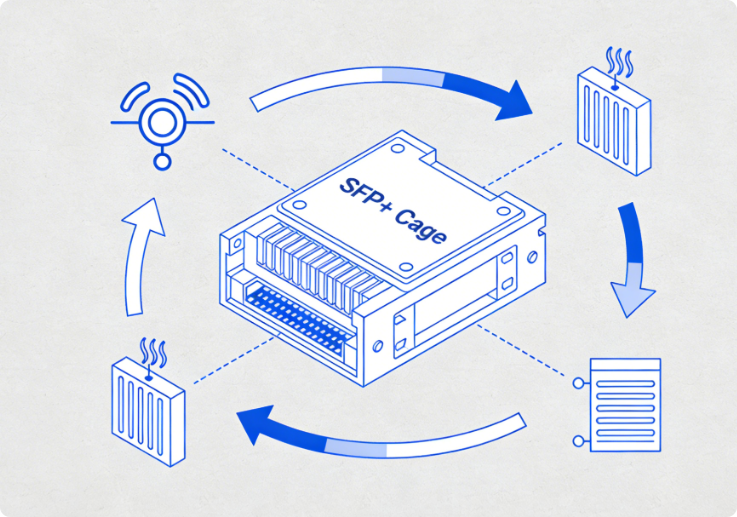
In fact, a large switch manufacturer once conducted thermal simulations on a 48-port all-copper module configuration. At the beginning, the manufacturer did not use cages with heat sinks, and the temperature of the 48 copper modules showed little improvement. Later they consulted GLGNET engineers, who suggested using SFP+ cages with heat sinks. After adopting GLGNET cages with optimized fin designs, the module surface temperature dropped by about 12°C, the fan speed decreased by 20%, and the overall noise and energy consumption of the device were significantly reduced.
This is only one of the advantages of SFP+ cages with heat sinks. In fact, GLGNET SFP+ cages are also equipped with high-quality EMI spring fingers, which solves the next issue.
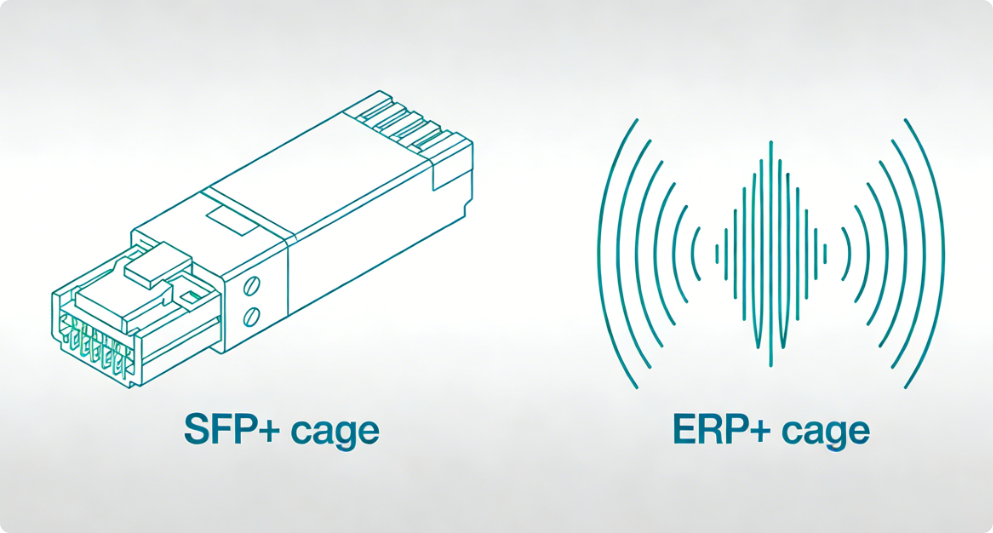
EMI Shielding Design of the SFP+ Cage
When we use SFP+ to RJ45 10G (10GBASE-T) modules, the signals transmitted through high-speed copper cables can generate interference. If these modules do not have proper shielding, the interference will accumulate and form “noise hotspots”. These noises not only affect the signal integrity of the module itself, but may also interfere with other modules in the same chassis or adjacent devices, leading to increased bit error rates or causing the equipment to fail EMC (electromagnetic compatibility) certification.
GLGNET engineers helped improve the previous EMI spring finger design and used high-quality spring contacts to reduce EMI radiation by about 20–30 dB. The bit error rate was also reduced by about 30%, and the stability of the system operation was greatly improved.
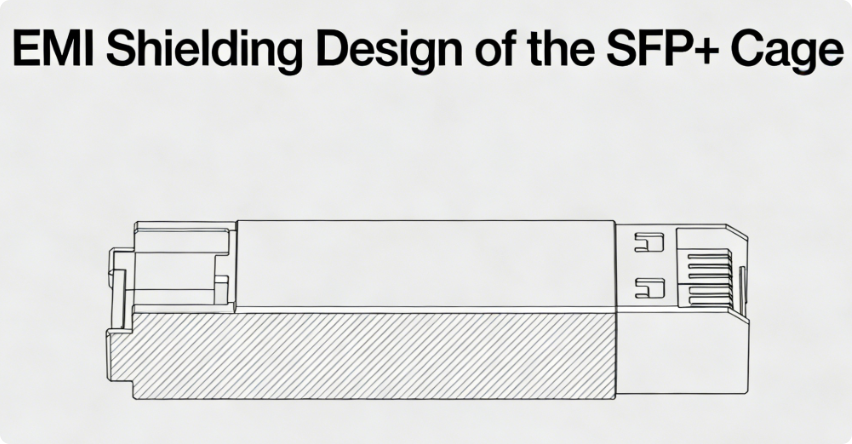
Through the drawings they created, the engineers explained in detail how the EMI spring fingers help the SFP+ cage provide comprehensive grounding and shielding. The spring fingers closely contact the metal shell of the module, forming a continuous conductive path with the cage, PCB, and chassis. In addition, they provide 360° metal shielding for high-speed signals, preventing electromagnetic wave leakage. However, high-performance spring contacts alone are often not enough. We also need to use metal housings made of highly conductive materials such as nickel-plated copper to ensure that high-speed signals follow the intended path and reduce signal crosstalk and noise interference. The SFP+ cage must also be grounded to the PCB through a metal base via soldering or screws, so that high-speed signals in the entire system can remain stable and the bit error rate can be reduced.
This is roughly the overall EMI shielding design process. Therefore, selecting the appropriate SFP+ cage for SFP+ to RJ45 10G (10GBASE-T) modules requires certain techniques. Next, we will show you some tips on how to choose the right cage.
If you would like to learn more about SFP cages and their solutions for large-scale deployments of 10G SFP+ to RJ45 modules, you can click to read that article.
Key Points for Selecting an SFP+ Cage
In actual network equipment design or module applications, selecting the right SFP+ cage is not simply a matter of matching the dimensions. Therefore, when choosing a cage we usually need to consider several factors, including standard compatibility, port density, thermal performance, and EMI shielding capability.
For equipment using SFP+ to RJ45 10G (10GBASE-T) modules, these factors are particularly important. This is because copper modules have higher power consumption, generate more heat, and operate at higher signal frequencies compared to traditional optical modules. If the cage design is not reasonable, it can easily affect the stability of the entire device.
1.Standard Compatibility (SFF-8431 / SFF-8432)
First, we need to ensure whether the SFP+ cage complies with industry standards. At present, the most commonly referenced standards for SFP+ equipment come from the SFF (Small Form Factor Committee), among which SFF-8431 and SFF-8432 are the most important compatibility standards. SFF-8431 mainly defines the electrical interface and high-speed signal specifications of SFP+ cages. This standard specifies the high-speed signal connection between the module and the motherboard, the power consumption range, and signal integrity requirements. SFF-8432 mainly specifies the mechanical structure and installation methods of SFP+ cages.
GLGNET SFP+ cages happen to meet both of these standards. Many well-known brands such as Huawei, ZTE, and TP-LINK use cages from this manufacturer, which can meet their requirements in network communication. This also shows that GLGNET SFP+ cages have gained their trust not only in terms of compatibility but also have a significant price advantage compared with other cage manufacturers.
2.Port Configuration Types
Different network devices have different requirements for port numbers and density, so SFP+ cages are designed with various port combinations.
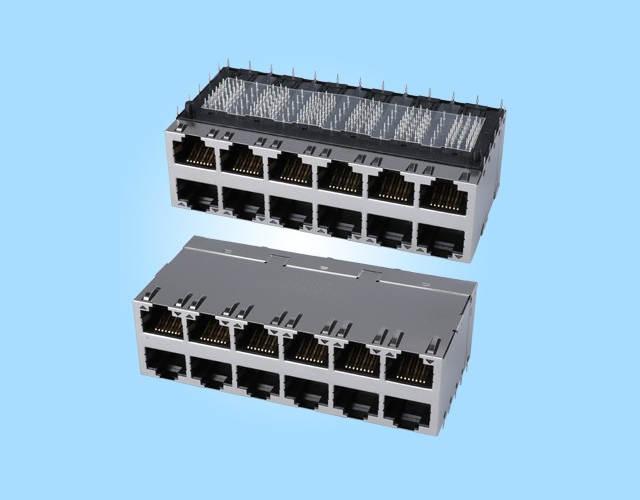
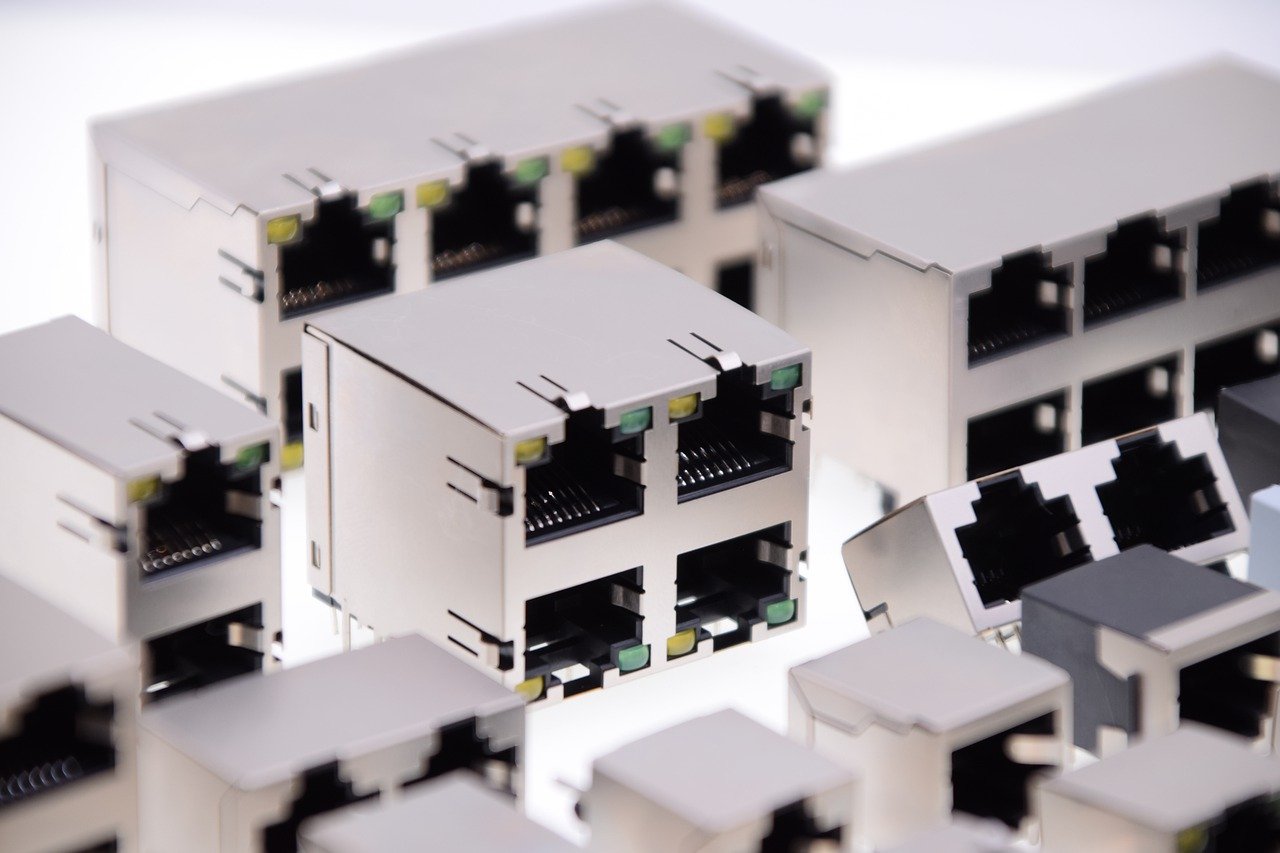
The most common is the GLGNET 1×1 single-port cage. This structure supports only one SFP+ module per cage. The design is relatively simple, and the spacing between modules is larger, providing more room for heat dissipation. Single-port cages are commonly used in industrial equipment, small switches, and network testing devices where port density requirements are not very high.
In enterprise switches or data center equipment, in order to increase port density, ganged cages are usually used. For example, GLGNET 1×2 or 1×4 SFP+ cages allow multiple modules to be supported within one integrated structure.
The advantage of this design is that it saves PCB space, increases device port density, and reduces overall cost. For example, in high-end switches, a 1U device may need to support 32 or 48 SFP+ ports, and high-density cages are an important way to achieve this design.
However, high-density designs also bring new challenges. For example, the distance between modules becomes smaller, which can easily cause heat concentration, more difficult heat dissipation, and increased electromagnetic interference. Therefore, when using multi-port cages, better thermal design and stronger EMI shielding capabilities are usually required.
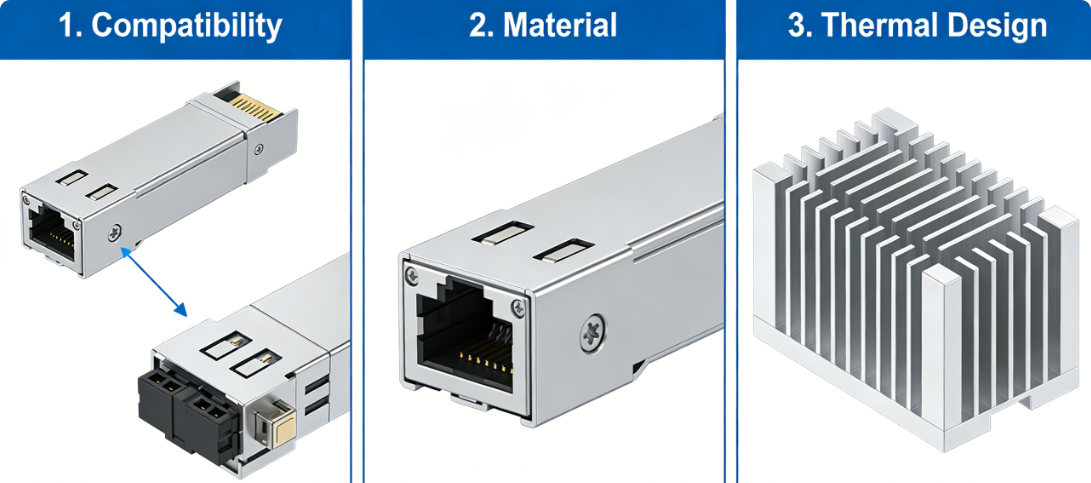
3.Thermal Structure Design
For equipment using 10GBASE-T SFP+ modules, thermal performance is a very critical indicator when selecting an SFP+ cage. According to technical information from multiple module manufacturers (such as Intel, Cisco, and GLGNET), the power consumption of 10GBASE-T SFP+ copper modules is usually between 2.5W and 5W. In comparison, ordinary SFP+ optical modules typically consume only 0.6W–1W of power. This means that copper modules may generate 2 to 5 times more heat than optical modules.
If the device’s thermal design is insufficient, the module may trigger the device’s thermal protection mechanism, resulting in automatic throttling, unstable links, or even disconnections. Therefore, when selecting an SFP+ cage, it is usually recommended to prioritize cages with thermal structure designs.
4.EMI Shielding Capability
Because 10GBASE-T modules transmit high-speed electrical signals through copper cables, electromagnetic interference issues are more obvious than with optical modules. If the shielding design is insufficient, the electromagnetic radiation generated during module operation may affect neighboring ports or other electronic components. As mentioned earlier, this is an important consideration.
5.Cable Compatibility
Network signals are transmitted through copper cables, so the cage design also needs to adapt to the signal environment brought by different cable types.
The most common 10Gbps network cables currently include CAT6a and CAT7. According to the IEEE 802.3an 10GBASE-T standard, CAT6a cables can support stable 10Gbps transmission over distances of up to 100 meters. CAT7 provides higher shielding performance and therefore performs better in environments with complex electromagnetic interference.
In actual cabling environments, there are also two different structures: UTP (Unshielded Twisted Pair) and STP (Shielded Twisted Pair). UTP has lower cost but relatively weaker anti-interference capability, while STP reduces external electromagnetic interference through a metal shielding layer.
Generally, GLGNET SFP+ cages can adapt to both shielded and unshielded cable environments, and ensure stable signal transmission through reasonable grounding structures and EMI shielding designs. This is particularly important for enterprise networks and data center applications.
Read more:
https://www.glgnet.biz/articledetail/top-5-sfp-cage-manufacturers-in-2026.html
https://www.glgnet.biz/articledetail/sfp-cage-with-emi-gasket-when-do-you-really-need-it.html
Conclusion
Overall, when using SFP+ to RJ45 10G (10GBASE-T) modules, the SFP+ cage is not just a simple structural component, but an important component that directly affects module stability and network performance. If you have any other questions, contact our GLGNET engineers and they will explain them to you in detail.